Monday, December 31, 2012

Animal of the Week December 31, 2012 -- Robin singing in the dead of night

While we're still in the middle of the 12 days of Christmas, I thought a festive edition would be in order. And inspired by my own private music box outside my window, this week's animal is Erithacus rubecula (robin).

As I turned off an episode of Deadwood of the day (S02E11) last night, the absence of Al Swearengen's foul language revealed a robin singing its slightly mournful but impressive song somewhere outside my window, high notes, low notes, trills...at midnight. I drifted off to sleep, dreaming of the wild west, and when I woke, inexplicably at 0430 h (the words "Miss Isringhausen" on my tongue), the bird was still at it. Someone should clearly tell this bird about the dawn chorus, no?

Not a nightingale   c PierreSelim/wikimedia commons
I previously wrote about the common confusion of robins with nightingales owing to their habit of singing at night. Certainly in London on December 31, not even in Berkley Square will you hear a nightingale. But fiercely territorial robins sing all year round and intensify their song as the breeding season approaches. So important is a robin's territory that they are often the first birds to strike up song in the dawn and the last to quiet at night. And in built-up environments they will sing throughout the night. Once thought simply to be due to the effect of street lighting, research suggests that robins sing at night to avoid noise pollution. As cities wake up, birdsong becomes drowned out by the human noises, so to effectively establish their territories, robins sing at night.

Other birds are thought to alter their calls to adapt to cities, with great tits changing the pitch of theirs so that it travels better and stands out more among the milieu of city noises.

The robin's association with Christmas is actually slightly convoluted. Postmen in Victorian times were nicknamed Robin Redbreasts because their red tunics recalled the birds, people looked forward to the cards brought to them by the Robins at Christmas time, and rather than stick a picture of a postman on a christmas card, some wag stationer ran with the idea and made the robin a festive symbol.

Many Christmas cards depict groups of robins clustered together, downy feathers puffed out on a twig in a snowy garden, but such a scene would never happen, for robins are highly territorial birds. Males will fight to the death in defence of their breeding territories.

Found throughout Europe but for the far north, in the UK, the robin is the stuff of Christian folklore: one of the explanations for the red breast is that it was stained by the blood of Jesus Christ when a brown robin perched on  the cross and sang to soothe him in his time of dying, all robins henceforth bore the mark. As an evolutionary biologist, this lamarckism strikes me as unlikely, but hard to test.

Monday, September 17, 2012

Animal of the Week September 17, 2012 -- hands off our badgers

It's a purple patch for the mustelids in terms of animal of the week, for this week's animal Meles meles (European badger), is a distant cousin of the otters, among the family of carnivores that also includes weasels, wolverines, polecats, martens, tayras, fishers, and ferrets.

It's not such a purple patch for the badgers of England, because the government has just issued the first culling licence to landowners in Gloucestershire, where it is hoped the cull will help to bring bovine tuberculosis under control. This preliminary licence will allow a consortium of landowners -- farmers, estate managers, and like -- to begin to cull badgers once they have proven that they have the funds to maintain a cull removing 70% of badgers for 4 years. The cull could begin in 3 weeks.

The possibility of culling badgers to reduce the damage caused by bovine tuberculosis has been considered for many years, to the extent that a randomised trial of badger culling was done to investigate the effects. The randomised badger culling trial ran for 9 years in the 2000s and was led by Professor Sir John Krebs, a highly respected scientist. In the trial, the tuberculosis incidence in areas in which badger culling took place was compared with that in areas where it did not. The study concluded that in areas where 70% or more of badgers could be culled, the incidence of bovine tuberculosis could be reduced by up to 16%. However, the study also found areas adjacent to culling sites that did not achieve a high badger mortality experienced increased incidences as infected badgers were displaced and moved to new homes. So the scientists concluded that culling badgers was not a particularly effective means of controlling tuberculosis, and if not done properly could lead to increased incidence of bovine tuberculosis.

Alternative approaches to reduce the impact of bovine tuberculosis are improved animal husbandry and hygiene, increased testing of cattle herds, more efficient exclusion of badgers from cattle sheds and pastures, and development of vaccines for cattle and badgers. There is a licensed badger vaccine, but that is costly to administer as large numbers of badgers would need to be caught and injected, so ideally an oral vaccine should be developed that can be given in bait. No cattle vaccine is licensed, because with the vaccines that are available, once given, because of the immune response it is impossible to tell a vaccinated cow from one that is infected.
Now, I am a pragmatist, and culling is essential in some settings. For example, since we did away with all our large predators, to maintain sustainable populations of herbivores, we have to fill that role in some woodlands to keep deer numbers in check so that trees can regenerate. But such culls should be based on necessity and evidence of benefit, not on pandering to pressure and not with ones eyes on votes and campaign funding for the next election. The badger cull is unneccessary, will lead to suffering for many animals, and could possibly lead to a huge decline in numbers of these delightful animals for a marginal or no benefit.

When I tweeted about the licence earlier, Defra kindly got back to me suggesting that scientists agree a badger cull could help, linking to a document summarising the conclusions of the culling trial. The document contains such supportive comments as these:
"If culling is not conducted in a coordinated, sustained and simultaneous manner according to the minimum criteria, then this could result in a smaller benefit or even a detrimental effect on confirmed cattle bTB incidence."
[Minimum criteria include taking out 70% of badgers, but the number of badgers is unknown, so no-one will know when 70% has been reached]
"In order to have a significant impact on national disease incidence, culling would need to be conducted over a very large area (bTB is currently considered endemic in over 39,000 square km of England – the area under annual bTB testing). The associated impact of culling at this scale on the national badger population is unknown."
"If culling is undertaken, it should be in addition to, not instead of, existing bTB control measures in cattle, which should be maintained and strengthened."
"Monitoring the implementation and impact of any badger culling policy, and the management of expectations, is of key importance."
[For which there is no plan.]
When interviewed about issuing of a the licence to cull earlier today, Krebs called the plan "crazy".

You can sign the petition to stop the cull here. It might be too late, although if the cull could be delayed to the closed season on December 1, then it could not take place again until June 2013 giving more time to make the government and farmers see sense.


Tuesday, September 11, 2012

Animal of the Week September 10, 2012 -- An Otter For Nutkins

Oh sad times. Television legend Terry Nutkins died on September 6 after a battle with leukaemia, at the age of 66. For many people of a certain age, Terry was the gateway to an appreciation of wildlife. Joining Jonny Morris on Animal Magic in the early 1980s, Nutkins contributed to the educational entertainment perfectly pitched for a young audience, with animal facts interspersed with silly voices, clunky special effects, and appearances from Terry's pet sealion Gemini. After Animal Magic came to an end, Nutkins went on to help create The Really Wild Show which ran for 20 years and launched the career of nature punk Chris Packham.

Otter c Franco Atirador
This week's animal, in honour of Nutkins, is a creature that inspired him, and certainly left its mark, Lutra lutra (Eurasian otter). As a young man Terry spent some time living in the Scottish home of Gavin Maxwell, who is best known for writing The Ring of Brightwater, a story inspired by a smooth-coated otter he bought back from Iraq and raised as a pet. While living with Maxwell, a European otter, Edal, bit the tips off two of Nutkins' fingers, a story that although fairly gruesome became the stuff of comedy. How many people have lost fingers to an otter? And despite this amputating encounter, Terry's passion for animals was undimmed and inspired several generations.


The Eurasian otter is the most widespread of all the otter species, and can be found from Ireland in the west to south Korea in the east and from Norway in the north to Sri Lanka in the south. They are also found in parts of north Africa. This distribution is testimony to their adaptability, and they live in a range of habitats from coastal waters to mountain streams, eating fish, frogs, crustaceans, molluscs, birds, and small mammals, even small beavers.

Otterhounds
During the last century, otters declined in much of their range due to habitat loss, use of pesticides, and hunting. In the UK the otterhound was bred specifically to hunt otters, it has an excellent sense of smell and webbed feet; but the outlawing of otter hunting in 1978 has since led to the decline in the number of otterhounds, such that they are now one of the rarest registered breeds. The protection afforded to otters and the banning of the most harmful pesticides and hunting has seen a dramatic return of the otter population across the UK. Where once they were restricted to the southwest and the wilder parts of Wales and Scotland, as of 2011, otters could be found in every county of England, including greater London (in 2006 the body of a full grown male otter was found run over in Wapping). But if you are lucky enough to encounter an otter, learn from Nutkins' loss and keep your fingers to yourself.

So, anyway, I'm not normally one to be affected by celebrity passing, but this AOTW is for you Terry! So long and thanks for all the animals.

Friday, August 31, 2012

Animal of the Week August 27, 2012 -- not a lion

Not a lion, Teddy Bear
On the August bank holiday, news broke that a lion had been spotted in the Essex countryside near Clacton on Sea. A LION! Local police and a firearms unit were rushed to the area along with experts from Colchester Zoo to search for the big cat. But after more considered assessment of the evidence, rather than an actual big cat, the animal spotted turned out simply to be most likely a big domestic cat...called Teddy Bear. Riding several days behind the crest of the wave as ever, this week's Animal of the Week is NOT a lion, but Felis sylvestris catus (domestic cat).

Stories of big cats living in the British countryside are common newsroom fodder, particularly in silly season—the few weeks at the end of the "summer" when political recess leaves editors with little news to report and suddenly people start seeing things such as the word Allah in an aubergine, Jesus's face in a slice of toast, Nick Clegg in an egg, and leopards in Leominster. Some people devote their lives to their obsession with Britain's big cats, although despite hours of grainy video footage and years of dedicated expert tracking no conclusive proof has ever been found. So, there really aren't big cats (in the lion, leopard, puma sense) in the UK.

Not a lion, Max
Nonetheless, professor Stephen Harris of the University of Bristol claims that populations of feral cats are growing to extraordinary sizes, some reaching as big as 4 ft. In Australia, where feral cats are controlled to protect native wildlife, the record is 5 ft 9 in (1 m 65 cm). His theory is that in the absence of the large predators one would expect, since wolves, bears, and lynx were eradicated from the UK by human beings, smaller predators such as feral cats and foxes are evolving to be larger in size so that they can exploit prey such as rabbits, gamebirds, hares, and even young deer and young sheep, which lack natural predators. Indeed, just 6 months ago the UKs largest fox — more than twice the average size — was caught in Aberdeenshire.

Not a lion, possibly possessed, Stanley
Domestic cats are descended from wildcats (Felis sylvestris), which have a natural range throughout Europe, Africa, the middle east, and the Asian steppes, most likely they are descended from the middle east and north African subspecies F sylvestris lybica, which began to associate with humans perhaps as early as 10 000 years ago. The story of cat domestication is probably unlike that of dogs, horses, and farm animals, which humans have substantially modified in their behaviour and body shape as humans harnessed the benefits of hunting and guarding companions, or sources of food or leather. The association possibly grew out of mutual toleration (a perfect marriage). As humans began to amass food stores in permanent settlements, cats would have been useful companions for their ability to kill rodents, cats would have benefited from the steady source of food. So while dogs, have been adapted for a variety of different functions, cats have always perfectly served their usefulness for people and their form remains almost unchanged from their wild counterparts. Only recently have people begun to mess around with the aesthetics of cats, producing such abominations as hairless sphynxes and stump-legged munchkins.

Indeed, so alike to wildcats are domestic moggies that they frequently interbreed with them, endangering the purebred gene pool of their cousins; in the wilds of Scotland, the last place where these felines persist in the UK, it's thought just a couple of hundred purebred wildcats remain.


Wednesday, July 18, 2012

Animal of the Week July 16, 2012 -- nice weather for, er...

The constant misery of the UK summer this year is reportedly having disastrous effects for many species—from bats to bees, songbirds, puffins, and butterflies—breeding success is down and some are threatened with local extinction. The saying goes that it's nice weather for ducks, although I suspect even they aren't faring particularly well; I've not seen a great swell in duckling numbers, and while not actually ducks, I know of at least one coot nest on the men's bathing pond on Hampstead Heath that was destroyed in a storm. One animal, however, for which the weather does seem to be particularly good news is Arion vulgaris (Spanish slug).

 At it A vulgaris c Zollernalb
The Spanish slug is considered to be one of the most damaging invasive species in the UK, where it was first recorded in the 1950s. Originating in the Iberian peninsular, the slugs lay 400 eggs in a single brood, expecting some of these to be dessicated by the arid conditions there; unfortunately further north in Europe, the damp weather—oh the damp damp weather—means that entire clutches hatch successfully. Moreover, in the north of Europe, they might be interbreeding with their native cousins black slugs (Arion ater) and becoming frost resistant, so populations are not checked by winter cold.

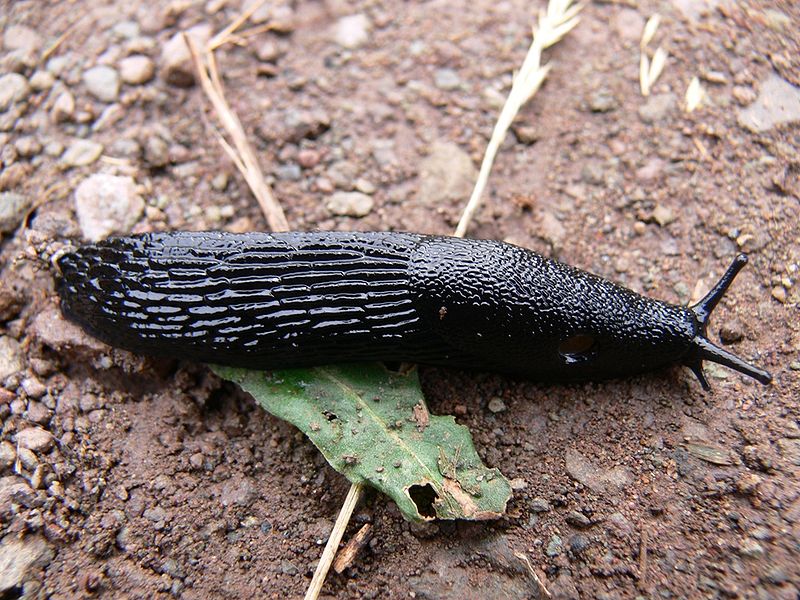
Frost tolerant A ater c Prashanthns
Favouring cultivated or disturbed land, the Spanish slug is now one of the most familiar slugs to people in the UK. This year they have rather disgustingly reached almost plague proportions; wreaking havoc in allotments, gardens, and farms up and down the country. Many agriculturalists are facing devastated crops not only because of the wet weather but also because of enormous amounts of slug damage.

Slugs will eat almost anything, from growing plants, to carrion, to faeces. Sur le continent, the Spanish slugs have been attacking snail farms: once they've dined on l'escargot they sometimes lay their eggs in the empty shells. Slugs in general seem particularly attracted to other dead or dying slugs. Apparently—and this is where you may need to hold onto your lunches—slugs pose a road hazard, as more and more are drawn to casualties on roads they can create dangerously slippy slicks of squished slugs.

How can you combat slugs? Egg shells, sharp sand, and coffee grounds are all supposed to repel them from tender plants; obviously slug pellets are an option and sales have rocketed this year, but they make sure you use the ferric phosphate kind if you must. Beer traps may catch a few; but let's face it, you'll just end up face down in a drunken stupour, covered in slugs in your garden if you try this. Copper wire around plant pots will stop them climbing in, and of course there's the old salt trick -- although that's not much use for gardeners as salt ain't good for your plants.

Christine Walkden of the Gardeners' Question Time panel last week came up with this stomach churning suggestion related with far too much glee. Collect the slugs from your plants, put them on a patch of pavement, squash them underfoot, leave for a couple of hours for other slugs to hone in on the squashed slugs, go out and trample those underfoot, repeat. This is what I inadvertently ended up doing on my way to and from the pub walking alongside Dartmouth Park Reservoir on Monday evening.*

*AOTW does not advocate the killing of any animals, although I acknowledge that some level of pest control may be necessary. You can encourage other animals that feed on slugs into your garden, but actually, the habit of slugs to curl up into a tough ball and secrete noxious mucus means that many animals will only really eat slugs as a last resort: blackbirds and hedgehogs are likely to be your best friends; badgers and wild boar are also predators of slugs, but also not that great for your garden.

Slugs head to toe
1, Slugs have two pairs of tentacles: the smaller lower pair are used as chemosensors, essentially they're the slugs' sense of smell; the top pair are tipped by the slugs' eyes.

2, The sadle shaped mantle is the real business part of the slug, housing it's organs including it's digestive tract, genitals, and lungs.

3, On the right hand side of the mantle, slugs have a pneumostome, an opening through which air enters the mantle.

4, Slugs are hermaphrodites, although some species still only reproduce in pairs, some, such as Arion vulgaris, will self-fertilize and can produce a fertile brood, if no mates are available.

5, The large part of a slug is its foot, a large muscular organ that propels the slug around on a film of mucus secreted by the slug.

Tuesday, July 10, 2012

Animal of the Week July 9, 2012 -- Spot the difference #1

So, here is the first in a series (given my output perhaps of one) of ramblings about the differences between things. The idea was prompted by a text message from my sister Sarah on Sunday asking "What's the difference between shrimps & prawns". Fortunately I had recently investigated this myself, so was able to reply that it's actually more of a semantic thing than a phylogenetic thing; although on revisiting the subject, I find that actually that's not the whole story, and it really depends on who you speak to and where they are from.

Classic curvy prawn
(Penaeus monodon)
Classic shrimp back bend
(Pandalus borealis)
In certain fields, distinctions are made between shrimp and prawns. For example, taxonomists classify decapod crustaceans (a grouping that also includes crabs and lobsters) of the infraorder Caridea as shrimp and those of the suborder Dendrobranchiata as prawns. And to some extent this works for the scientists: shrimp have two pairs of pincers and a hooked body among other defining characters, and prawns have curved bodies and three pairs of pincers. However, many animals called shrimps (miracle shrimps, mantis shrimps, and some freshwater "shrimps") and some called prawns (the Dublin Bay prawn for example) belong to completely different groups of crustaceans—neither prawns nor shrimps.

In common day parlance, this division works in some circumstances. For once, the Aussies have it phylogenetically spot on. In Australia (sorry Sarah, I got this wrong), the phylogenetic distinction is quite rigorously enforced: prawns are those animals of the family Penaeidae (those most closely related to the tiger prawn), whereas shrimp are the Caridea.

Brown shrimp (Crangon crangon)
In England the size distinction between "prawns" and "shrimps" fits generally with the taxonomic division. The brown shrimp (Crangon crangon) caught around the UK, boiled, shelled, and "potted" deliciously in butter belongs to the Caridea and is indeed a shrimp, and big fat tiger prawns (Penaeus monodon) have a long curved body and three pairs of pincers, so are clearly prawns. However, the north Atlantic peeled prawn in the classic prawn cocktail (Pandalus borealis) is actually a shrimp. In North America the word prawn is rarely used, with even the largest members of the Dendrobranchiata being served as shrimp. To illustrate the problem further, the freshwater prawns of the genus Macrobrachium, popular in the cuisine of south and southeast Asia, are despite their large size, actually members of the Caridea. And in aquaculture, the term "shrimp farm" is becoming increasingly used for any attempts to cultivate any of these animals.
 
Prawn cocktail (phylogenetic shrimp)
So what is a prawn and what is a shrimp depends on your field of interest—phylogenetic, agricultural, or gustatory—and where you are from. The terms "prawn" and "shrimp" are both used as slang, again with regional preferences, to refer to someone who has a good body but an unattractive face, this use is derived from the practice of eating the body but throwing away the head of these crustaceans.

Wednesday, July 04, 2012

Animal of the Week July 2, 2012 -- New balls please

Wimbledon is in full swing once again which can mean only one thing: rain. But attendant to the rain delays are quirky stories to fill up allotted hours of airtime. With Cliff Richard conspicuous by his absence, our focus has been on Andy Murray's balls falling out of his shorts and on this week's animal of the week Parabuteo unicinctus (harris hawk), specifically Rufus, the hawk used to prevent pigeon delays should the rain ever cease.

Harris hawks, native to the more arid regions of the USA, are unusual among birds of prey in that they hunt in groups: with previous years' chicks hanging around to help out their parents. When hunting, several birds will fly ahead while another flushes prey forward towards them -- like the velociraptors of Jurassic Park. Their social nature and their intelligence make them ideal for human use; and they are now the species most widely used in western falconry.

These hawks, as well as peregrine falcons, are commonly used in management of public spaces to deter pigeons. Around London, for example, the birds have been used at St Pancras Station, St Pauls, Trafalgar square, and Westminster Abbey to deter pigeons during major events. Rufus and his colleagues will also be zipping around the olympic site. Rufus hit the headlines this year as he went missing from Wimbledon last weekend when he was stolen from a van in which he had been left overnight. Fortunately he was left, unharmed, with the RSPCA and is now back on duty.


Here's a song fittingly called Army of Birds by the  marvellous Gaggle whose album launch gig I am off to this evening.

And here is a song about tennis players (well, it's not about tennis players, but the title suggests it might be and it is bloody beautiful).

As I leave this post Murray is one set down four games apiece in the second set of the quarter final against Ferrer. I very much enjoyed the candour of one Spectator I saw interviewed in the coverage:

BBC reporter: "Do you think Andy Murray stands a chance this year"
Interviewee: "No"