Monday, May 28, 2012

Animal of the week May 28, 2012 -- the shite of the bumblebee

Hey!

Three AOTWs in 1 month? You've got to be kidding, right? Because reintroductions of species lost from the UK is a favourite topic of mine, this week's animal is Bombus subterraneus (short-haired bumblebee).

Of the 25 species of bumblebee native to the UK, three have vanished and others are in rapid decline. The decline is thought to be largely due to loss of habitat and increased use of pesticides associated with intensification of agriculture since the end of the second world war. The last short-haired bumblebee was seen in the UK in 1988.

The short-haired bumblebee has, er, short hair, and is a long-tongued late emerging species. The Bumblebee Conservation Trust along with other conservation partners gathered 100 females from Sweden, after a couple of weeks in quarantine, checking their droppings to make sure they had no parasites or diseases, about 50 of these bees have been released at the RSPB reserve at Dungeness in Kent.

Finding 50 Swedish queens that are parasite and disease free is no mean feat, and it's hoped that these bees will now establish colonies at the reserve. The work of the conservationists planting wildflower meadows while preparing the site for the release has also been good news for other bee species: the shrill carder bee has returned after an absence of some years.

Welcome back short-haired bumblebee. May your colonies grow strong in the coming summer.

NB: this story is deficient in puns because the BBC got their first.

Wednesday, May 09, 2012

Animal of the Week May 7, 2012 -- y'alright cock

Female greater vasa parrot in mating plumage (forground)
Back in the mists of time, before the Baiji was declared extinct, before Tony Blair's Labour government was elected for a third term, before Boris Johnson became Mayor of London, before a million other sadnesses, animal of the week began because I wanted to find out what the "other" poisonous mammal was. As someone very interested in animals, particularly mammals and birds, I was stunned I had never heard before of a solenodon. Just recently I had a similar zoological epiphany when I discovered (on the internet -- not in an adventurous exploratory sense) Coracopsis vasa (the greater Vasa parrot).


I'm was extra surprised not to know about the vasa parrot, because it is from Madagascar and has weird sex (for a bird). And if there are two things sure to pique my interest, they are weird sexual behaviour and living on and island (cf  my favourite Amanda Donahoe film, Castaway).

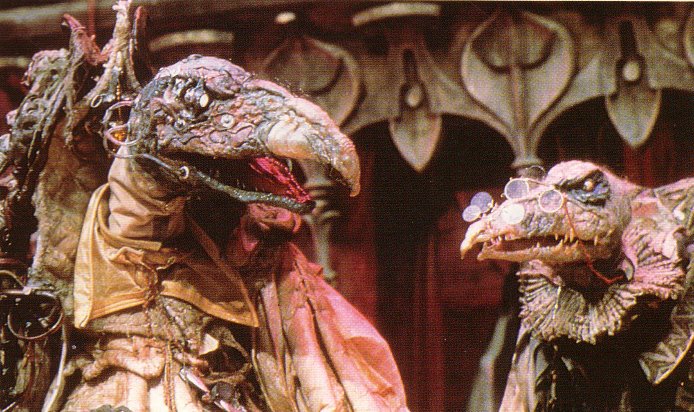
Perhaps one of the reasons these birds are overlooked in the natural history programmes is their slightly odd mating behaviour. While many are aware that dogs and wolves can become locked together during coitus in a copulatory tie, you rarely hear David Attenborough discussing this. And dogs are cute: by the time the vasa parrot female is linked to her mate (usually for half an hour sometimes for much longer) she has lost all the feathers on her head, which has turned bright yellow -- the couple, I imagine, bear a striking resemblance to copulating skeksis from the film The Dark Crystal.


Skeksis from The Dark Crystal
What makes the copulatory tie particularly special in these birds is that the presence of a penis-like organ is unique among parrots. Indeed, very few birds have such an organ: other notable exceptions include ostriches and ducks, which like the vasa parrot mostly keep their organ inside and only protrude it when mating. Most other birds exchange gametes through a cloacal kiss.

The mating system among these birds is also unusual because they are polygynandrous, with a female mating with several males. If kept in captivity, breeding is more successful if a single female is kept with two or more males. During the breeding season the females become very vocal and occasionally violent with reports of them killing males housed with them.


Despite the slightly adult themes of this AOTW, I'd like to dedicate this week's animal, squawking away on a distant island in their own wild rumpus, to Maurice Sendak, author of Where The Wild Things Are.

Tuesday, May 01, 2012

Animal of the Week April 30, 2012 -- back from the brynx?

(c) Programa de Conservación Ex-situ del Lince Ibérico www.lynxexsitu.es
Hola!

Animal of the Quarter is back again. And while England basks in glorious April rain (which doesn't seem to have been notified of the change of month) I thought I'd try to bring a little Iberian sunshine to my life and to yours, by posting an AOTW that I have been meaning to include in this blog for almost as long as I've been doing it. This week's animal is quite simply one of the most beautiful things I have never seen, and just a couple of years ago, few stood a chance of ever seeing Lynx pardinus.

The Iberian lynx is one of four species of lynx, including the Eurasian and Canadian lynxes and the bobcat. The lynxes are best known for their impressive facial hair and black ear tufts. Despite my own adventures in pogonophilia and the increasing prominence of my ear hair, I am not a lynx (rather depressingly my ear hair is mostly grey).

The Iberian lynx deserves special mention as it is the most endangered of all the big cat species (the Siberian tiger and Amur leopard, although vanishingly rare, are not distinct enough from other tigers or leopards, respectively obvs, to be considered species). Once scattered widely across the Iberian peninsular, the Iberian lynx is now found only in Donana national park near Seville and the Sierra Morena mountain range. Like money and Madeline McCann, it vanished from Portugal. If it were to become extinct it would be perhaps the first big cat to do so since the sabre toothed tiger (Smilodon).

In 2005 there was a population of just 100 or so in the wild, which has increased to perhaps 300 in the past few years. In 2012, the numbers have increased once again, with the release of captive bred individuals in April. With ongoing and quite productive captive breeding programmes in both Portugal and Spain, the outlook is less bleak, but still not assured for this stunning feline.

Tuesday, January 17, 2012

Animal of the Week January 16, 2012 -- world's smallest frog

P amauensis on a US dime
This week's animal of the week (and I bet the email out it gets blocked by a few oversensitive filters) Paedophryne amauensis is a newly described species of frog that is not only the world's smallest frog, but actually the world's smallest vertebrate.

First discovered in Papua New Guinea in 2009 by researchers scooping up handfuls of leaf litter whence they could hear the frogs calling from, the species was formally described last week in a paper in the journal PLoS One. The frog, with an average adult size of 7.7 mm in length, steals the smallest vertebrate crown from the small Indonesian fish Paedocypris progenetica of the carp family. The frog is one of several species in the genus Paedophryne, all from Papua New Guinea, and all of pretty diminutive size. Such extreme small size has evolved several times in the frogs and toads, but nearly always in wet tropical forests and nearly always among frogs that develop straight into small frogs in their eggs rather than going through a free-living tadpole stage.

Other notable small animals include the smallest lizards, two gecko species from the Caribbean, about 15-18 mm long (not including tails), and miniature chameleons from Madagascar of about the same size. Perhaps the most famous small animal is the bee hummingbird, which at 5 cm and less than 2 g in weight is scarcely bigger than a large bee; this species is also from the Caribbean, hailing from Cuba. This weekend, while watching Great Barrier Reef -- a highly entertaining BBC series available on iPlayer -- I was introduced to the pygmy seahorse, a quite exquisitely camouflaged 2 cm beauty. The position of smallest mammal is contested by the bumblebee bat from Thailand and Burma, which is about 3 cm in length and weighs about 2 g and the Etruscan shrew, which is about 3.5-5 cm long (tail excluded) but weighs less than the bat at about 1.5 g; these shrews are widely distibuted from southwest Iberia to Malaysia.

But all of these animals positively dwarf our tiny champion, this weeks animal of the week Paedophryne amauensis.

Monday, November 14, 2011

Animal of the Week, November 13, 2011 -- spoonbilled sandpiper

A couple of years ago, Chris Packham—a man who is currently peppering BBC's Autumnwatch series with titles of songs by The Damned—suggested that the giant panda should be allowed to go to extinction as the effort to save this evolutionary dead end would detract from more achievable conservation goals.

Recently, Murray Rudd of the University of York, UK did a survey to find out what conservation scientists thought of the idea. Turns out that 60% of scientists were in favour of some sort of triage system that might see some of the most endangered charismatic species put on palliative care until they breathe their last. Though specific species weren't named, one might guess at some of the species that might be included, they'd be the really rare ones that cost a lot to maintain—giant pandas, tigers, Javan rhinoceroses perhaps... And perhaps this week's animal, Eurynorhynchus pygmeus (the spoonbilled sandpiper).

As part of an effort to save the small wading birds from extinction, 13 individuals have been brought to the Wildfowl and Wetlands Trust at Slimbridge, Gloucestershire, from the breeding grounds in Chukotka—a peninsular in Russia's  far northeast (so far east that a bit of it is in the western hemisphere). With just fewer than 100 breeding pairs, habit loss and hunting on migratory routes to their southeast Asian wintering grounds could drive these birds to extinction in the wild in the next few years. Conservationists hope that if they can educate the people who hunt the birds and protect breeding grounds and stop-off points on the migratory routes they will one day be able to release the offspring of these captive birds back into the wild.


For the large part, these birds look like most other waders (small, brown, speckled, and indistinguishable to non-serious birders), but their odd spatulate bill used to filter small invertebrates from silt in shallow water sets them apart.

And herein lies the problem with a conservation triage scenario—people, including scientists, care more about certain things than others. Your passionate bird conservationists will want to save the spoon billed sandpiper, your tiger conservationist the tiger, whereas your scuba diver will probably want to protect coral reefs and let the sandpipers shuffle off to the last post. Triage might be a rational idea, but I guess consensus might be difficult to achieve.

Monday, September 05, 2011

Animal of the Week September 5, 2011 -- Come home cow

So, I have done 170 editions of animal of the week since the end of 2004, and yes, it is a well acknowledged fact that 52 weeks x 7 years far exceeds 170. A far more worrying statistic is that some BOFFINS recently estimated that there are 8.7 million species of plant and animal species in the world, and about 7.7 million of those were animals. So, if I were to feature every single animal that probably exists in the world as an Animal of the Week it would take me almost 150 000 years to do so. And that would rely on my doing one a week! Pigs (already done, so can't even tick a cheaky one off the list) might fly.

Right, I'd better crack on.

Yvonne
This week's animal is Yvonne the cow, or rather, in her honour. Given that I have so many animals to cover it's a bit foolish to do one that already got a look in (day 8 of course), but who can resist? Yvonne's excursion around the woods of Bavaria captured the headlines in Germany and beyond when she escaped the truck to the abattoir on May 24, and her capture captured more headlines on September 2, when she was captured. At first the farmer wanted Yvonne back, then German authorities wanted her shot. Then animal lovers around the world wanted her alive, and authorities decided to leave her be. Thankfully Yvonne was taken alive given a tasty dose of tranqs when she went to join another farmer's herd for company. The chap who caught her got a 100 000 euro award from a German Newspaper, and Gut Aiderbichl animal sanctuary in Austria, paid 600 euros to have her as a star attraction.

Aurochs on the rocks at Lascaux, Prof Sax
Yvonne's frolics in the Bavarian forests echoed those of her wild forebears. Cows are descended from aurochs (Bos primigenius) -- enormous wild cattle that from 250 000 years ago roamed from Portugal to Vladivostok and from Scandinavia to Egypt and Kerala. The ancient cattle feature heavily in Stone Age cave paintings and were likely important in the folklore of Eurasian hunter gatherers. Sometime not too many millennia after 10 000 years ago when sedentary human civilisations began to grow, they were one of the first animals to be domesticated. At least two populations of wild aurochs were domesticated, one in India giving rise to the humped cattle or zebu, and one in the middle east or Europe giving rise to cows like Yvonne. Habitat loss, hunting, and diseases spread by domestic cattle caused the populations of aurochs to dwindle and by the early 1600s just a small population remained in the forests of central Europe, the last individual died in 1627 in Poland.

Having survived into fairly recent history we've good accounts of what aurochs looked like -- 1.75 m at the shoulder (the largest domestic cattle reach about 1.5 m); the males black with a light stripe down their spine, the females red; and long lyre shaped forward sweeping horns. The genes of aurochs remain in domestic cattle, and in the early 1900s the Heck brothers tried to reawaken those genes by crossing together some of the more primitive European domestic breeds by breeding Heck cattle, a recreated aurochs, now used in some rewilding projects. The wild gene obviously still runs strong in some of the tamer domestic cows without this back-breeding, as Yvonne clearly shows.
What the Heck?! Walter Frisch

Some people have suggested that Yvonne could sense that she was about to be packed off to the abattoir and that is why she 'went aurochs'. It's a common story that some animals destined for the butcher's slab can sense their fate -- as a child I once sported an impressive black eye after a sheep we were trying to load onto a truck to the slaughterhouse leapt over my head (at least that's what my parents had me tell social services).

Monday, August 22, 2011

Animal of the week August 22, 2011 -- Funky monkey

Despite repeated promises to send more regular animals, I am red faced with embarrassment at my failure to do so, but it has been a busy summer and I've been rushing around exhausting myself till I am blue in the face -- but not as red and not a blue as the face of this week's (month's) animal of the week, Mandrillus sphinx (mandrill)

Mandrills are perhaps the most striking primates for several reasons. Not only are they they the largest monkeys, with the biggest males reaching a weight of 54 kg, they are also the primates with the greatest sexual dimorphism (difference in body size between the sexes) -- with females typically reaching just 14 kg -- just over a quarter the size of the largest males and half the size of the average male (although for extreme sexual dimorphism, see the green spoon worm). But what mandrills are best known for are their brightly coloured faces and bottoms.

Both the front and rear ends of mandrills are shaded with vivid blues and reds, the colours are brightest in the dominant breeding males. Mandrills are rather poorly understood creatures and the precise functions of the bright skin colours are unknown, though they no doubt help communicate since the intensity of colours increases not only with sexual dominance but also with agitation and excitement. Mandrills live in forests in Cameroon, Gabon, Equatorial Guinea and Congo (Brazzaville) where the bright colours and a scent gland on their chests might help communication in dense vegetation. Mandrill groups typically consist of up to 20 females and their offspring led by one dominant male, although several of these groups may frequently associate with each other in large gatherings called hordes -- some hordes may number over 1000 making them the largest gatherings of non-human primates.

Other primates with bright or noticeable rear ends include drills (the closest relatives of mandrills, which lack the brightly coloured faces), baboons, and chimpanzees -- baboons have large red backsides all the time to create a cushion for upright sitting and female chimpanzees to advertise fertility. Another primate with similarities between its arse and face (in terms of appearence and what comes out) is David Cameron.

Figure courtesy of Robert Young, wikimedia commons