Monday, December 11, 2006

Animal of the Week December 11, 2006 -- Top trumps start here

Well, 11 doors (okay okay, 12) open on the advent calendar, and what was it today...

Little Equus asinus (donkey), little donkey on the dusty road
Got to keep on plodding onwards with your precious load
Been a long time, little donkey, through the winter’s night
Don’t give up now, little donkey, Bethlehem’s in sight
Ring out those bells tonight
Bethlehem, Bethlehem
Follow that star tonight
Bethlehem, Bethlehem
Little donkey, little donkey had a heavy day
Little donkey, carry Mary safely on her way

You may be surprised that I have not plumped for one of those deep-sea species all over the news like a bad case of crabs this week... well, they're just not festive enough. But following on from one red-top paper's lead of giving the deep-sea organisms a tenacity score for their ability to hang on to life at the margins of possibility. Here is the first AOTW top trump card! A series that you and your friends can cut out and keep (I'm sensing the must-have gift X mas 2007 here).

Donkey
Number of legs:
4
Celebrity a-like: Alanis Morissette 78
Top speed: 35 mph
Tenacity: 4
Likelihood of hurting James Blunt: 86%*
Aesthetically pleasing: 4
Violence: 4
Can be kept on a roof terrace: (miniature donkeys) 3
Religiousity: Popular in monotheistic religions and Seth of the ancient Egyptian pantheon had a Donkey's head 65
Special skill: Burden 68

*Aroused by the braying sound of Blunt's voice, donkey uses one of his more famous attributes (frequently used in a popular simile [yeah, that's right kids, "kick like a donkey"]) to ensure that Blunt won't be thinking about sitting down at a piano to write songs for a while.

The origins of the word donkey are unknown, but it became widely used only in the 18th century. Perhaps because at that time, pronunciation of the word ass matched that of the word "arse", so the historically more popular word fell out of use to save blushes. Later, pronunciation of ass changed back to the way we know it today, but in American English 'arse' was lost all together and ass became the word for deriere. Donkey might be a diminutive form of the word "dun" (a common donkey colour) and originally pronounced to rhyme with "monkey".

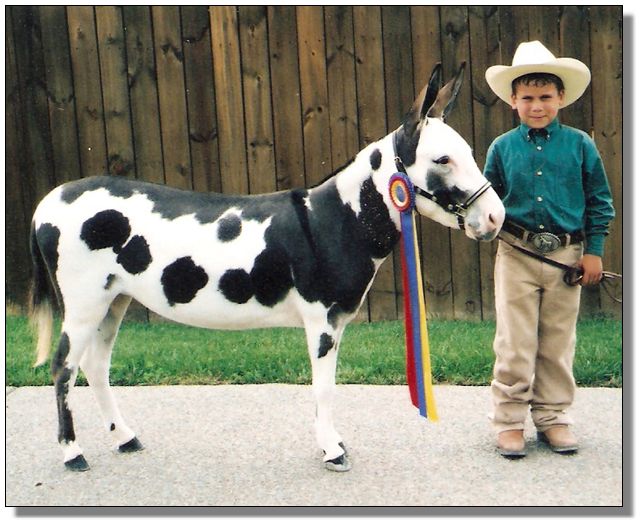
Donkeys feature commonly in the bible, and in many stories mentioning that a man was riding a donkey was to imply wealth, as they were the biblical equivalent of sports cars. Maybe if Joseph and Mary actually had a sports car they'd have got a proper room. The young chap in this week's picture is certainly pleased as punch to own the nippy little model at his side. A miniature donkey!

Computer-game star Donkey Kong was not, in fact, a donkey but earns the moniker due to his stubbornness.

Next Week... Christmas!

Cheers All,

Monday, December 04, 2006

Animal of the Week December 04, 2006 -- Tis the season.... to be eaten

And what was on the door of Animal of the Week's advent calendar this morning?

Maleagris gallopavo (turkey). Over 45 million turkeys will have been eaten over Thanksgiving in the US, then just a few weeks later another 22 million will be eaten in US at Christmas, in the UK we’ll get through another 11 million or so… these are tough times for this week's animal.

The popularity of turkey at Christmas and Thanksgiving is actuality a recent addition to harvest and midwinter traditions. The only foodstuffs documented at the Plymouth pilgrims' feast with the Wampanoag in 1621 were venison and waterfowl, Queen Elizabeth favoured goose at Harvest Festival, Americans probably later switched to turkey as they were more abundant. Until the middle of the 1900s turkey was something of a luxury in the UK. In Dickens' A Christmas Carol, when Scrooge has had some festive goodwill spooked into him, he saves the Cratchits from the "goose club" by purchasing a prized turkey for them.

Intensive farming and the development of new double-breasted breeds (large and well-dressed) has made turkeys a popular choice for large family gatherings. Male turkeys, called gobblers or toms, naturally woo females, or hens, by displaying with their bright blue snood (the extendable protrusion above their beak) and wattle, a fanned tail, and elaborate gobbling. Many industrially farmed turkeys cannot mate of their own accord (the toms are lucky if they can walk, let alone gobble) and so the females have to be artificially inseminated. That is, unless they manage to reproduce without mating, as turkeys are want to do. Traditional breeds of turkey resemble more closely their wild North American forebears and are able to breed naturally, walk, run, and fly. They also taste nicer and require less farm trickery to raise them.

Surprisingly nippy, wild turkeys can fly well and can run at speeds of up to 55 miles per hour! They need to. In the southern USA, fried turkey is a popular dish, and a Turkeyfryer has been developed in which a whole bird can be deep fried, I was amused but not surprised to find out about this.

This is turning into a bit of an essay, but I couldn't finish without pondering why an American bird is called turkey. There are several theories about its origins: it's a corruption of the native word, firkee; it's derived from turka, the Indian (Asian sub-continent) name for peacock, the Americas were originally thought to be attached to India; it comes from a tendency for English speakers to name exotic things after exotic places; or perhaps most likely, it was originally thought to be related to the African helmeted guinea fowl (Numida meleagris), which was called a Turkey-cock as it was imported to Europe through Turkey, and so the turkey was also called a Turkey-cock. The name stuck in North America, but when the guinea fowl's origins were better understood, they were renamed. Convoluted I know, but I like it that way.

Monday, November 20, 2006

Animal of the Week November 20, 2006 -- Don't step on my blue suede flippers

Hello Ani-freaks

Sometimes, I'd just like to leave you with a picture. And ideally this would be one of those weeks. But then regular readers know that I don't know when to leave well-enough alone.

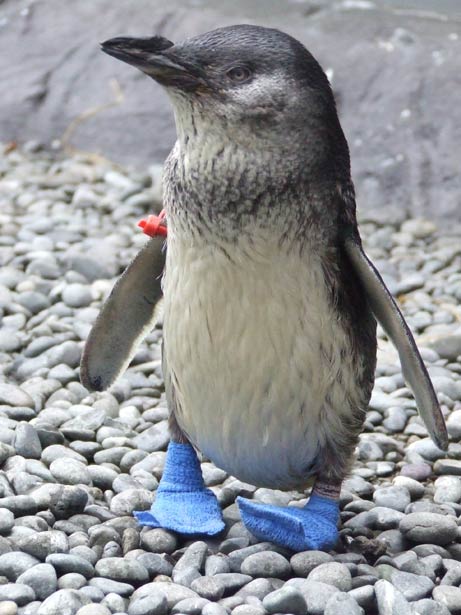
This week's animal is Eudyptula minor (fairy penguin, little penguin, little blue penguin, or Kororā). The smallest species of penguin is a resident of New Zealand and southern Australia. Rescued fairy penguins in the Antarctic Center in Christchurch, New Zealand, have been spending too much time hanging out on the shingle flexing their wings, rather than swimming in their pool. Their idle posing has led to calluses on their feet, and these natty little daps have been developed along with a regimen of saltwater footbaths to cure their foot injuries in preparation for their return to the wild.

Unendangered, widespread, and a popular tourist attraction, the fairy penguin is one of the luckier animals featured in animal of the week. However, one threat to the fairy penguin is that of rebranding. In April this year, staff at Sea World, Queensland, Australia, were planning to rename fairy penguins as they felt the name might offend gay men... or fairies as they are clearly more popularly known.

Anyway, wouldn't bother this one, look how chuffed it is with its new shoes. Definitely a female.

Cheers all,

Monday, November 13, 2006

Animal of the Week November 13, 2006 -- The witchetty grub eats the witchetty shrub

Take the phone off the hook, put down your copy of War and Peace, cancel all appointments you may have for the next few weeks. For, thank the lord, I’m a Celebrity Get Me out of Here is back! Sorry non-UKers, you won’t be able to watch this marvel of televisual entertainment in which ten of our top media figures battle with the elements and the insects with the aim of being crowned king or queen of the jungle. If they succeed they will join such cultural behemoths as Kerry Katona and Joe Pasquale (do you know how hard I find it not to use Pesci instead of Pasquale – now that would be worth watching) on the fast train to Iceland! If they fail, well, it’s a short trip back to obscurity (unfortunately they do come back).

No doubt, at some point over the next few weeks, a squealing nobody will bravely chow down on one of this week’s animals in a bushtuckertrial. For this week’s animal is Xyleutes leucomochla, (cossid moth, witchetty grub). These native Australian delicacies are actually the larvae of any one of several beetle or moth species, but most commonly they’re cossid moth larvae.

Witchetty grubs rather poetically feed on the roots of witchetty shrubs. They grow fat on the sap, storing up energy for a fleeting life as an adult. The moths are the size of sparrows, and the grubs may be 7 cm long and as fat as your finger (if you’ve got fat fingers like me).

Eaten raw they provide tasty snacks with leathery skin, sweet flesh, and a liquid centre (like liqueur chocolates in a sausage skin). If you prefer, you can, in true Australian style, throw them on the barbie—after such treatment they will taste like chicken (of course – what doesn’t?) or prawns with peanut butter. To people survivining in the outback, these larvae can be a lifeline, for TV producers, they're another titilating, humiliating stunt!

So who will end up eating the witchetty grubs? Will it be 1980s newsreader Jan Leaming, Tony Blair’s sister in law Lauren Booth, ex-Joseph Jason Donovan, ex-Footballer’s wife Phina Oruche, or ex-Mr Minelli and current Mr Potato Head David Guest? You’ll just have to watch to find out.

At least we know it won’t be flamboyant designer, Scott Henshall (no me neither), who has said that he will not eat any creepy crawlies; so no doubt the producers will be feeding him the testicles this time – which was probably, after having seen a snippet of him on the show, his thinking all along.

Oh, and this week's picture, there is a witchetty grub in his hand, and well, it's only a matter of time before one of them is on IACGMOOH, right?

I thank you,

Tuesday, November 07, 2006

Animal of the Week November 6, 2006 -- Roll up, roll up, see the freakshow dolphin

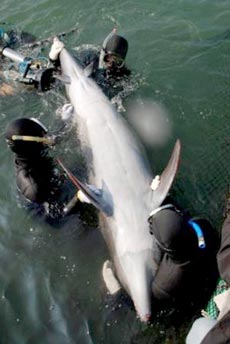
In honour of the forefinned and hindfinned, four-finned specimen caught off the coast of Japan this week, animal of the week is somewhat predictably Tursiops truncatus (bottlenose dolphin).

Bottlenoses are some of the largest dolphins and have a worldwide distribution in tropical and temperate waters. They are the typical dolphinarium dolphin, splashing spectators and firing their keepers out of the water for our entertainment in many a water park. But, as you may well have seen for yourself, they generally have only the paired pectoral fins and a dorsal fin.

So, why the bejesus does this Japanese one have four paired fins? Is it part of this highly intelligent species' plan for world domination? Will they be freeing up their forelimbs for the use of weapons of the modern age such as guns, knitting needles, or paparazzo cameras? Can we expect to see a beaky crusader creeping up the street with its sights on our pints any time soon?

Unlikely.* Fortunately for the future of the human race, this aberration is probably caused by the accidental switching on of an ancient gene that did once lead to the development of hind limbs. Believe it or not, dolphins, whales, and porpoises belong to the same group of animals as cows, giraffes, and camels -- the artiodactyls or even-toed ungulates. The closest living relatives of whales and dolphins are hippos; and rather surprisingly, cows, sheep, deer, and giraffes are more closely related to whales and hippos than they are to camels. Some innovative hippo-ish creature took the extra four-legged steps into the ocean about 50 million years ago. The whales and dolphins never looked back, becoming supreme marine mammals and streamlining by losing their hind limbs.

Atavistic features, such as this dolphin's hindfins, are not common, but nor are they unheard of: dolphins and whales with pelvic fins have been found before; and Alexander the Great's horse, Bucephalus, was said to have had additional toes with hooves resembling those of the ancestral horse merychippus. Do human's show atavistic traits, I hear you ask? Well, anyone unfortunate enough to have seen my back in my recent and advancing years will have witnessed, firsthand, evidence of our furry origins.

I thank you,

Peter Hayward
Head Keeper
Animal of the Week

*Just in case any of you sly bastards are reading this, you can keep your fins off my beer, alright.

Monday, October 30, 2006

Animal of the Week -- October 23, 2006 -- See a bird in another bird's mouth

Well, it's sawhain again, time to cut up some fishnet stockings, pile on the face paint, perfect walking around your house with the lights off to fool the trick-or-treaters into thinking there's no-one at home, and get a pumpkin ready to drive off the malevolent forces that will try to possess you this Tuesday night.

For many a Londoner, the most despicable creature, surely an instrument of the devil and harbinger of ill is the pigeon. Not that we hate pigeons per se (naturally I don't, I love all the animals), but the abundance, omnipresence, and pestilence of these "rats with wings" is a constant reminder of all that is ill with society. There are a few crazies, probably in cahoots with the dark lord, who think that feeding the toeless, tumour-ridden aves will, in some way, help them. It won't, it will just enable them to breed more quickly and so increase the number of sick birds spluttering, stumbling, and dripping on our polluted city streets. Feed them less, they'll breed less, and a smaller population of birds will be healthier and cleaner.

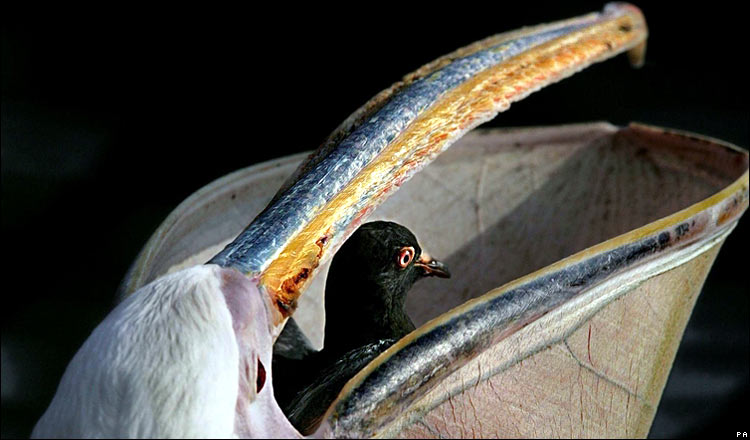
Anyway, last week, the arrival of an unlikely champion in the battle against the number of pigeons (note, not against the birds themselves) appeared: Pelecanus onocrotalus (eastern white pelican, great white pelican). One of the four eastern white pelicans that inhabit Duck Island in the park's lake was photographed snaffling a pigeon. The pelican held its victim in its beak for about 20 minutes before managing to get the pigeon facing head first for the trip to the pelican's belly. Although pelicans are much better known for their consumption of fish, the head first principle of swallowing scaly finny fish also applies to feathery wingy birds.

Now, there have been great hopes for the return of the peregrine falcon to London, and its role in reducing the numbers of pigeons, but I have seen a peregrine make a kill in London, and what did it kill? It killed an ickle starling. Rubbish, let's get in more pelicans.

There have been pelicans in St James' Park since the Russian ambassador gave some as a gift to Charles II in 1664. In less prescriptive times when the birds' wings weren't clipped, one used to nip up to the Regents Park zoo and steal the fish at feeding time. The flaps of skin from pelicans' bills have been used as tobacco pouches and, even more inventively, as sheaths. Fish, baccy, pigeons, members, and spent semen -- truly, a peculiar bird is a pelican, its beak can hold more than its belly can.

Peter Hayward
Head Keeper
Animal of the Week

Monday, October 23, 2006

Animal of the Week -- October 23, 2006

Guess who?! That’s right, it’s me! Hiya!

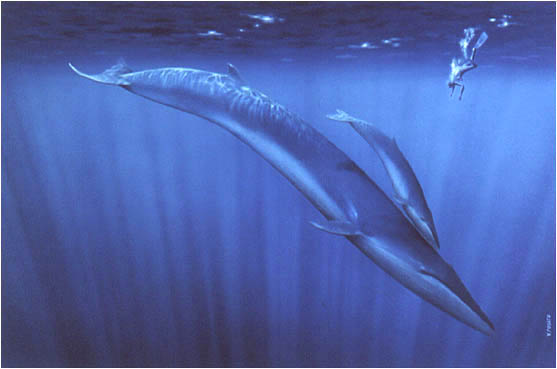
Just a heads up, you have only a few minutes left to buy your Iceland Air all inclusive tickets for the Sugarcubes’ gig in Reykjavik on November 17, 2006—yes, Bjork will be with them (http://www.icelandair.co.uk/home/packages/our-best-deals/detail/store65/item52342/?gclid=CKLMs-PKjYgCFRtNEgodoFROHQ). Of course if you are a fan of this week’s animal of the week, you might think twice about going to Iceland . This week’s animal of the week is the second biggest animal in the whole wide world Balaenoptera physalus (fin or finback whale), that goes in and out of the harbour.

Although it is the fastest species of whale, reaching speeds of 37 km per hour, one hapless individual was not able to outpace the Icelandic whaling boat that was the first to head out on Iceland ’s resurrected commercial whaling enterprise. The 20 m whale was harpooned in the north Atlantic. I said "Ouch! this really hurts".

Iceland, along with Norway, has decided to resume commercial whaling and will take nine fin whales and 30 minke whales between now and next August, even though the International Whaling Commission still bans the killing whales for non-research purposes. Japan continues to capture whales for scientific research. I will shortly be conducting my own scientific research on an egg sandwich. I’ve got to eat something otherwise I’ll die.

Most estimates put the northern hemisphere population of fin whales at about 5000 and the southern hemisphere population at about 1000 and the species is classified as endangered by the Intenational Union for the Conservation of Nature. Icelandic authorities reckon there are may be as many as 20 000. Quantifying the numbers of ocean animals isn’t the easiest thing, but there may not be plenty more whale in the sea. Fin whales grow to 25 m long and maybe 70 000 kg, they dine on tiny krill (very small shrimp-like animals). Indeed, they don’t really like lobster (like lobster).

Of course if you do find yourself in Iceland and you pass a butcher, you may like to make a purchase, and you'll need to know what to do with it:

Joint of Whale Meat Steeped in Red Wine Marinade
6–8 portions:
1 1/4 kg of whale meat
3 dL red wine
1 dL vegetable oil
3 ground cloves
1/2 tsp coarsly ground pepper
2 tsp of salt
The Marinade
3/4 L juices from the meat
Thickening (milk and flour)
4 dessert spoonfuls of sour cream
Sugar
Salt
It may be a good idea to bind the joint to help it keep in good shape. Place it in a small oven dish and pour the marinade over. Leave the joint there until the next day, turning it at regular intervals. Remove the joint from the dish, dry it well and rub it with salt. Cook the joint until it turns a pleasant brown colour all over, turn down the heat, and add water to reach 2–3 cm up the side of the joint, approx. 3/4 L. Let the joint simmer for about 20 min, turn it over and leave it for another 20 min. Measure enough of the juices to make enough marinade, about 3/4 L. Add the thickening to the marinade, and then the sour cream to taste. Serve with boiled beans or other vegetables, and boiled or fried in the pan.

Ahhh, it’s good to be back.

Ta

Peter Hayward
Head Keeper
Animal of the Week