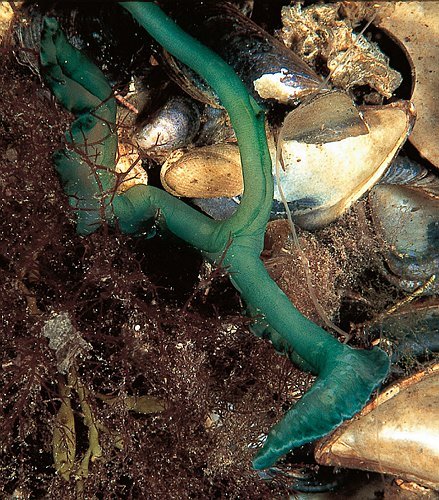
 Oh hello... it's you... welcome. It's been a while, well, a week. Come in, sit down, put your feet up.... how rude of me, how terribly rude, let me introduce you to Bonellia viridis (green spoon worm), this week's Animal of the Week. Green spoon worms were brought to my attention by the recent Channel 4 tv series Dr Tatiana's Sex Guide to All Creation. These worms live in the Pacific ocean and are special for three main reasons. 1: They have the greatest sexual dimorphism of any species, but unlike many familiar species, in which the males are bigger (eg, humans), female green spoon worms are bigger than males, 1000–2000 times bigger to be approximately precise. 2: Males live inside the ovaries of females in a chamber called the androecium, they absorb nutrients through their skin because their mouths are too busy spewing sperm. 3: Even though they have this bizarrely extreme and extremely bizarre differentiation between the sexes, their sex is not genetically determined; whereas, for example, mammal males have an X chromosome and a Y chromosome and females have two X chromosomes, green spoon worms have no gender-defining genetics. Their sex is determined by the events in the first three weeks of their lives; if they don't meet another green spoon worm they settle down on a rock and become a 2 m long female; however, if they run into one of these mammoth worms they are swallowed by her and become a male, never growing bigger than 1–2 mm.
Monday, May 16, 2005
Animal of the Week May 16, 2005 -- I appear to have a man in my ovaries
Oh hello... it's you... welcome. It's been a while, well, a week. Come in, sit down, put your feet up.... how rude of me, how terribly rude, let me introduce you to Bonellia viridis (green spoon worm), this week's Animal of the Week. Green spoon worms were brought to my attention by the recent Channel 4 tv series Dr Tatiana's Sex Guide to All Creation. These worms live in the Pacific ocean and are special for three main reasons. 1: They have the greatest sexual dimorphism of any species, but unlike many familiar species, in which the males are bigger (eg, humans), female green spoon worms are bigger than males, 1000–2000 times bigger to be approximately precise. 2: Males live inside the ovaries of females in a chamber called the androecium, they absorb nutrients through their skin because their mouths are too busy spewing sperm. 3: Even though they have this bizarrely extreme and extremely bizarre differentiation between the sexes, their sex is not genetically determined; whereas, for example, mammal males have an X chromosome and a Y chromosome and females have two X chromosomes, green spoon worms have no gender-defining genetics. Their sex is determined by the events in the first three weeks of their lives; if they don't meet another green spoon worm they settle down on a rock and become a 2 m long female; however, if they run into one of these mammoth worms they are swallowed by her and become a male, never growing bigger than 1–2 mm.

Monday, May 09, 2005
Animal of the Week May 09, 2005 -- The largest primate ever
 Good Monday one and all,
Well, it seems like a while since I have done a terrestrial mammal, so, here's one. Unlike last week's animal which was recently rediscovered, this week's animal, Gigantopithecus blacki, is very much extinct. The origins of the genus Gigantopithecus are somewhat hazy, but they were likely distant cousins to orangutans and even more distant cousins to humans, chimps, and gorillas; this species was roaming around China and parts of southeast Asia 1.5 million to 500 000 years ago. What makes G blacki such a noteworthy species is that it was the largest known primate to have ever lived. Your modern day gorilla and extinct giant lemurs and baboons come nowhere close. Conservative estimates put G blacki at 8 ft tall and about 800 lbs, but some people reckon males might have reached 1200 lbs (about the size of a cow!). G blacki was identified from fossilised teeth sold in chinese apothecaries as "dragon bones", which palaeoanthropologist von Koeningswald realised must have belonged to a massive primate. Despite its size, evidence of silica granules in the teeth suggest that G blacki ate bamboo -- no one is quite sure why G blacki became extinct, but it is just possible that these are the only animals ever to have been outcompeted by giant pandas. Although there is no evidence of their existence beyond about 400 000 years ago, some people suggest that elusive extant G blacki are behind the stories of yetis and bigfoot.
Monday, May 02, 2005
Animal of the Week May 02, 2005 -- Phoenix woodpecker
 Dear Friends,
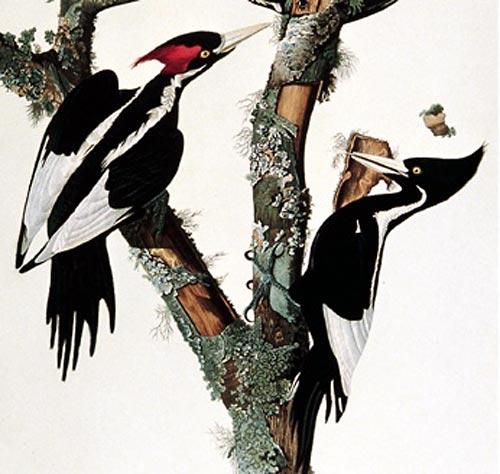
This week's animal of the week is Campephilus principalis (ivory-billed woodpecker). You've probably all heard a lot about this species, and I'm sure you followed with great interest the story of its rediscovery in the Big Woods of Arkansas last week, but I am so excited about this I can't not have it as AOTW! Indeed, one put-upon recipient is hearing about this from me for the second time. Anyway, ivory billed woodpeckers were thought to have become extinct on the North American mainland as a result of habitat destruction in the 1940s; the Cuban subspecies was last sighted in 1986 and is also feared extinct. However, the rediscovery of its mainland cousin gives hope that the Cuban is still hanging on in remote forests. Ivory-billed woodpeckers are the third largest woodpeckers and are predominantly black and white, males have a red crest (presumably the Cuban subspecies is more red). Numbers and range of the birds in North America are unknown, but for them to have survived the past 60 years there must be a short-term sustainable breeding population. The latin name Campephilus does not mean "lover of drag acts", rather "lover of grubs". I like to imagine that the pair in this picture by the father of American natural history, John James Audobon, are planning where they can hide out for a century or so before surprising a naturalist or a naturist.
Other notable mention: while we are on the subject of phoenix like reappearences, Hippotragus niger variani (giant sable) deserves a namecheck. Thought to have been killed off by local hunters 30 years ago it has been rediscovered recently in an area of Angola only reachable on foot (there a tasteless joke there, but I'll let those of you with such minds come up with the punchline yourselves).
This week, Animal of the Week reaches Outer Mongolia and Cornwall.
Monday, April 25, 2005
Animal of the Week April 25, 2005 -- Nautilus
 Hello Animal Freaks!
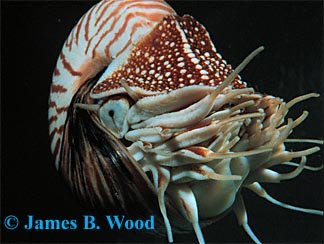
This weeks animal of the week is Nautilus pompilius (chambered nautilus). I thought it was about time we had a cephalopod is all. There are seven species of extant nautiloids today in two genera (Nautilus and Allonautilus). N pompilius is one of the more common species, but even so, little is known about these animals. During the ordovician era (510-420 million years ago) nautiloids were very common in the oceans and the species much more diverse -- some had shells up to 1·5 m across. Nautiloids clung on to the present day unlike their not dissimilar cousins, ammonites (the spiral-shell fossil things that crop up everywhere), but their time was passed and other cephalopods without external shells (tasty ones like squid and octopus [licks lips]) have become much more prominent. Nautiluses live only in the western pacific, swim slowly, breed slowly, and are pretty, all of which puts them in danger of exploitation. Do you remember making pinhole cameras in school, nautiluses have pinhole-camera-like eyes with no lens -- their eyes are filled with sea water.
See a Russian rock group called Nautilus pompilius http://www.nautilus.ru/
Monday, April 18, 2005
Animal of the Week April 18, 2005 -- Interspecies loving
 Hello Lovelies,
This week's animal of the week is a tricky one, normally I just rattle off the latin name, put the common name in brackets after, and then launch into the informative and entertaining text about the animals. But, in a break with style, this is not about a whole species, rather it's about Kekaimalu and her un-named daughter -- the worlds only known wholphins! 19 year old Kekaimalu was born from an unholy union between a female bottle-nosed dolphin (Tursiops truncatus) and a male false killer whale (Pseudorca crassidens). Now, the saucy thing has gone and had a female calf with another bottle nosed dolphin. Typically species hybrids are infertile (mule's, for example, so rarely are able to have offspring that such an event is considered a portent of Armageddon in parts of north Africa), so no-one expected the only wholphin to be able to reproduce. The convention for naming hybrids (who knows about mule) is to combine the first part of the sire species' common name with the latter part of the dam species' common name, hence wolphin--in researching this week's animal I came across the example of li-liger (cat sired by a lion with liger dam [male lion X female tiger]), so really this new thing is a do-wolphin! Other hybrids include ligers and tigons, leguars, lijaguleps (I kid you not). Some of you may be interested in this website, which contains, among the many battles, an account of a fight between a lijagulep and a giant anteater http://www.bobsanimalfights.com/index.html.
Monday, April 11, 2005
Animal of the Week April 11, 2005 -- Charlie Bustard
Hello All, I hope this finds you well.
This week's animal of the week is Otis tarda (great bustard). Great Bustards are sometimes said to be the world's heaviest flying birds, but some people reckon that accolade goes to (insert joke re fat women on planes) the kori bustard. Whatever, at 20 kg, Otis tarda has to be up there (ostriches, I know you want to know this, weigh up to 160 kg). Now, the exciting thing for those of us who live in the UK is that they're back.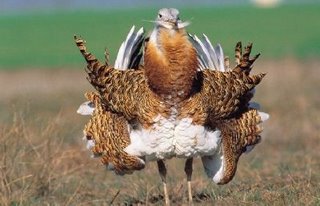 After an absence of 200 years or so chicks rescued from abandoned nests in Russia (there you go, folks in Russia, a reference for you -- now email your mothers, they're worried) have been introduced to Salisbury plain. So, next time you're dancing around stone henge for some ritual or another and a great big shape blocks the sun, it might not be a plane, it's definitely not superman, it's not even an average bustard, but it might just be a great bustard. I like to think that the male in the photo is playing a game with a friend in which they each take it in turns to try and look like another animal.
This week's animal of the week is Otis tarda (great bustard). Great Bustards are sometimes said to be the world's heaviest flying birds, but some people reckon that accolade goes to (insert joke re fat women on planes) the kori bustard. Whatever, at 20 kg, Otis tarda has to be up there (ostriches, I know you want to know this, weigh up to 160 kg). Now, the exciting thing for those of us who live in the UK is that they're back.
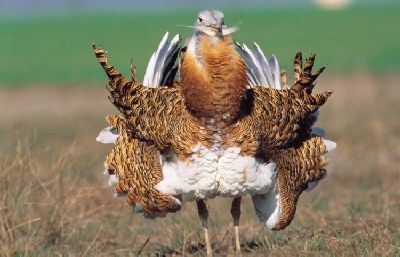 After an absence of 200 years or so chicks rescued from abandoned nests in Russia (there you go, folks in Russia, a reference for you -- now email your mothers, they're worried) have been introduced to Salisbury plain. So, next time you're dancing around stone henge for some ritual or another and a great big shape blocks the sun, it might not be a plane, it's definitely not superman, it's not even an average bustard, but it might just be a great bustard. I like to think that the male in the photo is playing a game with a friend in which they each take it in turns to try and look like another animal.
Monday, April 04, 2005
Animal of the Week April 04, 2005 -- Yes, there is a stink badger
 Hey Kids,
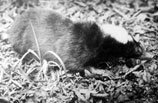
This week's animal is, believe it or not, Mydaus javanensis (Sunda stink badger). Stink badgers are just two some of the crazy sounding badgers of southeast Asia: Imagine the Formosan ferret badger or the Hog badger. Sunda stink badger's are found at high elevations on Sumatra and Java in Indonesia and Borneo in Malaysia. Stink badgers secrete a noxious smelling liquid from glands around their anuses; and their affiliation with either true badgers or skunks is hotly debated by them as debates these things.
 In some parts of their range they are occasionally eaten by indingenous people as a cure for fevers. Apparently they sometimes live in porcupine burrows with the porcupines...imagine that it stinks and it's full of spines. In Norwegian they are called Stinkgraevling. (apologies for the pictures both being small, but there's no way I'm not having sunda stink badger as animal of the week this week)
Subscribe to:
Posts (Atom)