Monday, March 21, 2005

Animal of the Week March 21, 2005 -- Immigration special

Ah spring,
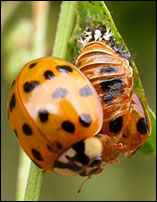
The daffodils are fluttering and dancing in the breeze, the birds are nesting, lambs are gamboling in the field, and any day now the bees will be a buzzing, butterflies will be flitting lazily by, and what else? Ladybirds of course! Specifically Harmonia axyridis (harlequin).
In the far-east where they are native, harlequins are a colourful, varied, and versatile component of the food web, feeding on aphids, nectar, fruit, beetle eggs and larvae, and many other things. In non-native countries, away from their natural parasites and predators, harlequins are pernicious invaders feeding on native ladybirds' food and even native ladybirds. In about 20 years from their introduction as biological control organisms in the southeastern USA, harlequins have become the most common ladybird species in North America. And now, harlequins have landed in the UK. They first appeared last year and look set to have similar success here as they have on mainland Europe and in the US. There is a survey in the UK to track the spread of this species across the country, if you would like to get involved go http://www.harlequin-survey.org/. So, look out for this AOTW as the weather warms up, and cherish the other ladybird species you spot as you go about it.

Monday, March 14, 2005

Animal of the Week March 14, 2005 -- Curly-coated piggywig

Hi One and All,
This week's animal is Sus scrofa (domestic pigs and wild boar). New research published in the past week suggests that, rather than being domesticated once and spread as farmers moved around, wild boar have been domesticated in at least five separate locations--from Europe, to the Near East, to southeast Asia--in the past 9000 years. Despite appearing in a great array of forms, from the miniature pigs of Vietnam and polynesia to the huge pink land-race creatures, all pigs are the same species as wild boars, with which (size allowing) they can breed quite merrily. One of my sources (http://animaldiversity.ummz.umich.edu/site/accounts/information/Sus_scrofa.html) contains the following: "Not only can they [pigs] perform repetitive circus tricks, such as jumping through hoops and walking tightropes, but they can also solve simple problems such as opening a bolted door." Hands up anyone who would not pay to see a pig on a tightrope.
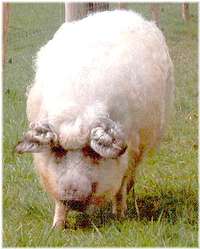
The pig pictured here is a Mangaliza from the central plains of Hungary. I wanted to send a picture of the now defunct breed the Lincolnshire Curly Coat, sadly the only picture I could find was too small (and I got it in the neck about the vampire finch picture last week).

Monday, March 07, 2005

Animal of the Week March 07, 2005 -- Vampire birds of Wolf Island

Happy Second Week of March guys,

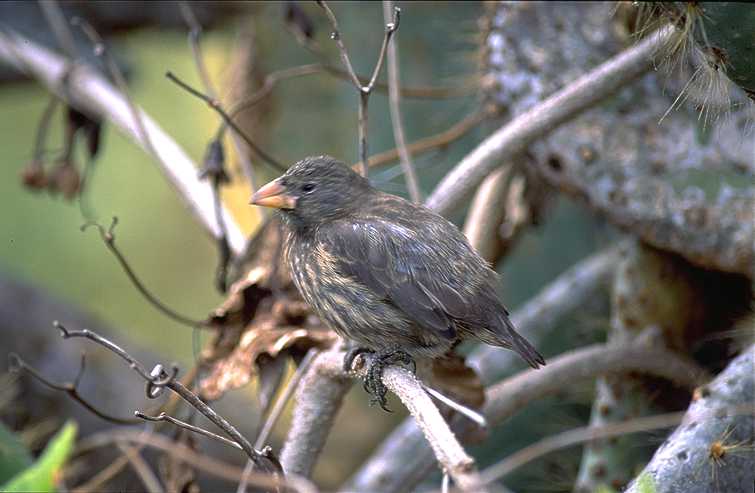
This weeks animal of the week is Geospiza difficilis (sharp-beaked ground finch). This inocuous looking LBJ (a birders' classification that stands for little brown job) is notable for a couple of reasons. Geospiza may be familiar to you as the genus of finches found on the Galapagos Islands. As they arrived on the remote archipelago, various ecological roles were not occupied so the birds diverisfied to fill these roles and eventually became distinct species. Although this radiation is commonly said to have led Darwin to the theory of evolution by natural selection, it is not so. Darwin's collection of finch specimens was slapdash at best and the significance of all the similar looking LBJs occupying different niches on the Galapagos was not recognised until years later. An unlikely role occupied by Geospiza difficilis (from the ominously named Wolf Island [not Wolf Lake, that's a whole different mailout]), is that of vampire. These little birds climb onto the backs of nesting or resting boobies (like gannets), peck at the skin until the blood starts running, and lap up the resulting flow.
(image from: http://www.justbirds.org/Galapagos/Sharp-beaked%20ground-finch.htm)

Monday, February 28, 2005

Animal of the Week February 28, 2005 -- Giant Clam

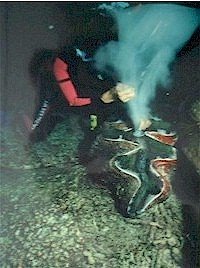
This week's animal of the week is Tridacna gigas (giant clam). These tropical bivalves are the heaviest of all the molluscs (mysterious/fictional giant squid notwithstanding), they grow up to 1.3 m across and can weigh up to 250 kg (that's 4'4" and 550 lb for our imperial American friend). Although depicted in many an adventure story trapping the foot of a happless pearl diver, there is not a single documented case of someone being drowned by a giant clam, indeed some of the largest ones can't close there valves fully. Instead of dining on divers extremities, giant clams obtain most of their food from symbiotic algae (zooxanthellae), although Tridacna gigas does obtain some (~10%) of it's nutrients by filtering phytoplankton and zooplankton from sea water. These clams live in shallow coral seas and are found no deeper than 20 m below the surface. They breed by ejaculating vast numbers of eggs and sperm into the sea, which makes me wonder about the diver in this week's picture.

Monday, February 21, 2005

Animal of the Week February 21, 2005 -- River dolphin

Hi,

First of all, my apologies for the lateness of AOTW, obviously the biggest losers are the animals which only get the title for a few days. I hope never to be so tardy again.

This week's animal of the week is Inia geoffrensis (Amazon river dolphin or boto). Botos are the the largest river dolphins (other species found in South and Central America and Asia) and reach a maximum size of about 2.5 m. These are some of the only dolphins that can bend their necks, as the vertebrae aren't fused. From the mouth of the Amazon to the foothills of the Andes, botos—which can be bright pink in colour (although white is more common)—feature strongly in Amazon folklore, some indigenous people believe botos can transform into human form at night, come onto land, and cause harm to people who have been naughty (or twee). When the river floods, botos leave the chanel and swim among the tree trunks and low branches of the forest in search of a fish supper.

Monday, February 14, 2005

Animal of the Week Ferbuary 14, 2005 -- The most dangerous animal in the world

This weeks animal is the most deadly of all the animals, but it also pretty small. Human malaria is cause by four different species in the genus Plasmodium. Plasmodium falciparum is the most dangerous of these species. There are upwards of 300 million cases of malaria (~5% of the world's population) and in excess of 2 million malaria deaths each year. The picture here is of a macrogametocyte among some human blood vessels. The male and female Plasmodium gametocytes are taken up by female mosquitos when they drink human blood, there the males parasites fertilise the females, progeny develop, and these then migrate to the mosquito's salivary glands... etc etc etc

Monday, February 07, 2005

Animal of the Week February 07, 2005 -- Alligators

Before this date AOTW existed, and I know what the animals are from the dates of when the images were saved, unfortunately, I had no idea that AOTW would become a blog and I didn't keep them all.
I posted the AOTW from an internet cafe in New Orleans on the day before Mardi Gras 2005. I had by then tasted alligator stew. It was quite delicious.
I probably said something about distinguishing alligators from crocodiles. With their mouths closed you cannot see the teeth of alligators, whereas crocodiles' bottom teeth stick out.
Otherwise who knows. I had a great time in New Orleans, amazing. I feel so very lucky to have been able to go to what will likely turn out to have been the last proper Mardis Gras.