Monday, April 25, 2005

Animal of the Week April 25, 2005 -- Nautilus

Hello Animal Freaks!
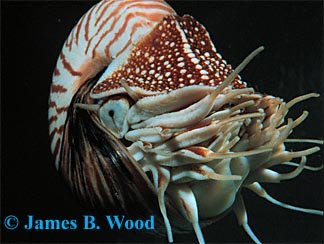
This weeks animal of the week is Nautilus pompilius (chambered nautilus). I thought it was about time we had a cephalopod is all. There are seven species of extant nautiloids today in two genera (Nautilus and Allonautilus). N pompilius is one of the more common species, but even so, little is known about these animals. During the ordovician era (510-420 million years ago) nautiloids were very common in the oceans and the species much more diverse -- some had shells up to 1·5 m across. Nautiloids clung on to the present day unlike their not dissimilar cousins, ammonites (the spiral-shell fossil things that crop up everywhere), but their time was passed and other cephalopods without external shells (tasty ones like squid and octopus [licks lips]) have become much more prominent. Nautiluses live only in the western pacific, swim slowly, breed slowly, and are pretty, all of which puts them in danger of exploitation. Do you remember making pinhole cameras in school, nautiluses have pinhole-camera-like eyes with no lens -- their eyes are filled with sea water.
See a Russian rock group called Nautilus pompilius http://www.nautilus.ru/

Monday, April 18, 2005

Animal of the Week April 18, 2005 -- Interspecies loving

Hello Lovelies,

This week's animal of the week is a tricky one, normally I just rattle off the latin name, put the common name in brackets after, and then launch into the informative and entertaining text about the animals. But, in a break with style, this is not about a whole species, rather it's about Kekaimalu and her un-named daughter -- the worlds only known wholphins! 19 year old Kekaimalu was born from an unholy union between a female bottle-nosed dolphin (Tursiops truncatus) and a male false killer whale (Pseudorca crassidens). Now, the saucy thing has gone and had a female calf with another bottle nosed dolphin. Typically species hybrids are infertile (mule's, for example, so rarely are able to have offspring that such an event is considered a portent of Armageddon in parts of north Africa), so no-one expected the only wholphin to be able to reproduce. The convention for naming hybrids (who knows about mule) is to combine the first part of the sire species' common name with the latter part of the dam species' common name, hence wolphin--in researching this week's animal I came across the example of li-liger (cat sired by a lion with liger dam [male lion X female tiger]), so really this new thing is a do-wolphin! Other hybrids include ligers and tigons, leguars, lijaguleps (I kid you not). Some of you may be interested in this website, which contains, among the many battles, an account of a fight between a lijagulep and a giant anteater http://www.bobsanimalfights.com/index.html.

Monday, April 11, 2005

Animal of the Week April 11, 2005 -- Charlie Bustard

Hello All, I hope this finds you well.

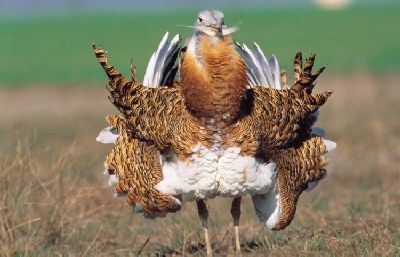
This week's animal of the week is Otis tarda (great bustard). Great Bustards are sometimes said to be the world's heaviest flying birds, but some people reckon that accolade goes to (insert joke re fat women on planes) the kori bustard. Whatever, at 20 kg, Otis tarda has to be up there (ostriches, I know you want to know this, weigh up to 160 kg). Now, the exciting thing for those of us who live in the UK is that they're back. After an absence of 200 years or so chicks rescued from abandoned nests in Russia (there you go, folks in Russia, a reference for you -- now email your mothers, they're worried) have been introduced to Salisbury plain. So, next time you're dancing around stone henge for some ritual or another and a great big shape blocks the sun, it might not be a plane, it's definitely not superman, it's not even an average bustard, but it might just be a great bustard. I like to think that the male in the photo is playing a game with a friend in which they each take it in turns to try and look like another animal.

Monday, April 04, 2005

Animal of the Week April 04, 2005 -- Yes, there is a stink badger

Hey Kids,
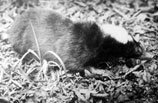
This week's animal is, believe it or not, Mydaus javanensis (Sunda stink badger). Stink badgers are just two some of the crazy sounding badgers of southeast Asia: Imagine the Formosan ferret badger or the Hog badger. Sunda stink badger's are found at high elevations on Sumatra and Java in Indonesia and Borneo in Malaysia. Stink badgers secrete a noxious smelling liquid from glands around their anuses; and their affiliation with either true badgers or skunks is hotly debated by them as debates these things. In some parts of their range they are occasionally eaten by indingenous people as a cure for fevers. Apparently they sometimes live in porcupine burrows with the porcupines...imagine that it stinks and it's full of spines. In Norwegian they are called Stinkgraevling. (apologies for the pictures both being small, but there's no way I'm not having sunda stink badger as animal of the week this week)

Monday, March 21, 2005

Animal of the Week March 21, 2005 -- Immigration special

Ah spring,
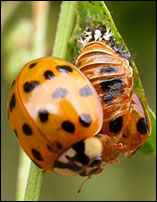
The daffodils are fluttering and dancing in the breeze, the birds are nesting, lambs are gamboling in the field, and any day now the bees will be a buzzing, butterflies will be flitting lazily by, and what else? Ladybirds of course! Specifically Harmonia axyridis (harlequin).
In the far-east where they are native, harlequins are a colourful, varied, and versatile component of the food web, feeding on aphids, nectar, fruit, beetle eggs and larvae, and many other things. In non-native countries, away from their natural parasites and predators, harlequins are pernicious invaders feeding on native ladybirds' food and even native ladybirds. In about 20 years from their introduction as biological control organisms in the southeastern USA, harlequins have become the most common ladybird species in North America. And now, harlequins have landed in the UK. They first appeared last year and look set to have similar success here as they have on mainland Europe and in the US. There is a survey in the UK to track the spread of this species across the country, if you would like to get involved go http://www.harlequin-survey.org/. So, look out for this AOTW as the weather warms up, and cherish the other ladybird species you spot as you go about it.

Monday, March 14, 2005

Animal of the Week March 14, 2005 -- Curly-coated piggywig

Hi One and All,
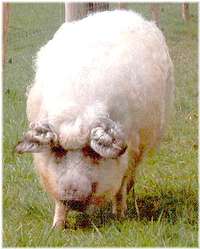
This week's animal is Sus scrofa (domestic pigs and wild boar). New research published in the past week suggests that, rather than being domesticated once and spread as farmers moved around, wild boar have been domesticated in at least five separate locations--from Europe, to the Near East, to southeast Asia--in the past 9000 years. Despite appearing in a great array of forms, from the miniature pigs of Vietnam and polynesia to the huge pink land-race creatures, all pigs are the same species as wild boars, with which (size allowing) they can breed quite merrily. One of my sources (http://animaldiversity.ummz.umich.edu/site/accounts/information/Sus_scrofa.html) contains the following: "Not only can they [pigs] perform repetitive circus tricks, such as jumping through hoops and walking tightropes, but they can also solve simple problems such as opening a bolted door." Hands up anyone who would not pay to see a pig on a tightrope.
The pig pictured here is a Mangaliza from the central plains of Hungary. I wanted to send a picture of the now defunct breed the Lincolnshire Curly Coat, sadly the only picture I could find was too small (and I got it in the neck about the vampire finch picture last week).

Monday, March 07, 2005

Animal of the Week March 07, 2005 -- Vampire birds of Wolf Island

Happy Second Week of March guys,

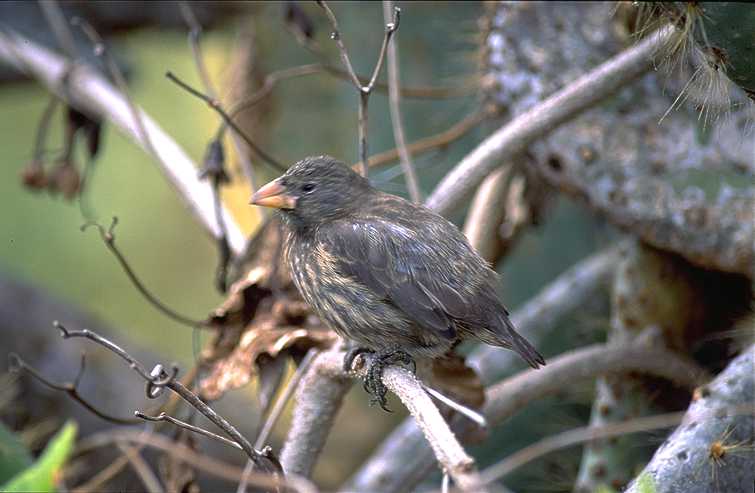
This weeks animal of the week is Geospiza difficilis (sharp-beaked ground finch). This inocuous looking LBJ (a birders' classification that stands for little brown job) is notable for a couple of reasons. Geospiza may be familiar to you as the genus of finches found on the Galapagos Islands. As they arrived on the remote archipelago, various ecological roles were not occupied so the birds diverisfied to fill these roles and eventually became distinct species. Although this radiation is commonly said to have led Darwin to the theory of evolution by natural selection, it is not so. Darwin's collection of finch specimens was slapdash at best and the significance of all the similar looking LBJs occupying different niches on the Galapagos was not recognised until years later. An unlikely role occupied by Geospiza difficilis (from the ominously named Wolf Island [not Wolf Lake, that's a whole different mailout]), is that of vampire. These little birds climb onto the backs of nesting or resting boobies (like gannets), peck at the skin until the blood starts running, and lap up the resulting flow.
(image from: http://www.justbirds.org/Galapagos/Sharp-beaked%20ground-finch.htm)