Monday, August 01, 2005

Animal of the Week August 1, 2005 -- Camel spiders of Iraq

Hello Animal Freaks!
This week's animal of the week is Galeodes arabs (sun spider, camel spider, wind spider, wind scorpion). The most common question people ask when I start talking about Animal of the Week is "will you shut up about this for just five seconds?" Another common question is "will you ever do a made-up animal?" And, like Julia Roberts' character in Pretty Woman with regards to kissing on the lips, I say "no, it's one of my rules". Camel spiders are therefore an interesting case; a few years ago troops in the middle east derived fun in the homely way of mocking up photos of giant spiders that ate human flesh. This urban (desert?) legend did the rounds on the world wide web and were emailed around, and everyone thought there was a foot-long, ten-legged spider biting chunks out of people and camels. Someone mentioned this to me the other day and they still thought it true! Durr, spiders don't have ten legs! Durr, spiders don't grow to a foot long! Durr, that's not even a spider, it's a solifugid? These arachnids aren't spiders. They don't even really have ten legs, the first pair of limbs are large, modified mouth parts (pedipalps). And they don't grow to a foot long. Galeodes arabs is one of the biggest with a 5 inch leg span and 2 inch body. Here is a real picture, without scale you can't tell it's not a foot long, but take my word for it, it's not, I wouldn't lie, not to you.

Monday, July 25, 2005

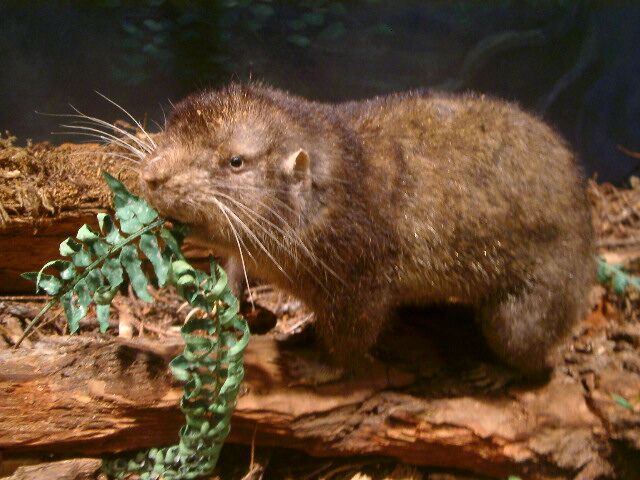
Animal of the Week July 25, 2005 -- Mountain beaver

Neither an inhabitant of mountains nor a real beaver, this weeks animal of the week is Aplodontia rufa (mountain beaver, sewellel). These medium-sized rodents are of an ancient North American lineage that has changed little for millions of years. Their primitive kidneys are unable to concentrate urine so they have to drink loads of water. Like several other rodents, sewellels are copraphagic–ie, they eat their own doings! Several subspecies live in a limited range in America's western states. When threatened or spooked, they secrete a thick rheumy liquid from their eyes, why they do this is not clear, and it doesn't really sound like a great defence to me, but last time I looked I wasn't a burrowing rodent of a group ancestral to squirrels. Apparently they are grumpy animals that wouldn't make good pets, but if I had a pet mountain beaver I would call it Brian. Then I could say to people that "Brian sewellel is a weepy-eyed, sh*t-eating beaver".

Monday, July 18, 2005

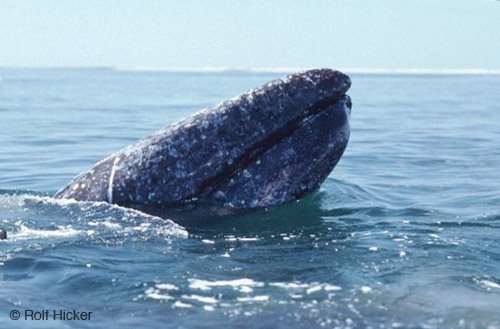
Animal of the Week July 18, 2005 -- Bring back the grey whale

Wow, I almost forgot about animal of the week, senility! This week's animal is Eschrichtius robustus (grey whale, gray whale, devilfish). Grey whales (15 m long, 36 tons heavy) were once widespread throughout the Atlantic and the Pacific but their love of shallow coastal waters proved disasterous when whaling really took off as an extreme sport in the 1700. By the late eighteenth century there were no more grey whales in the eastern Atlantic, soon after they were gone from the western Atlantic. Populations clung on around South Korea and around the western coast of the USA. The US population of gray whales has recovered so much that two academics from University of Lancashire at Penrith will, at a conservation meeting in Brazil, suggest that several dozen of their 26 000 whales be flown to Cumbria to re-establish an east Atlantic population. Given the joy of having the great bustard back in the UK (although I've yet to see one) and the ever growing number of red kites along the M40, I am all for this (although one is unlikely to a whale wheeling gracefully in the skies over the Stokenchurch cutting). Grey whales were named devilfish (tch! fish?!) by early whalers because mothers fiercely defend their calves when threatened. Their only natural enemies besides human beings are killer whales who apparently favour the tongue and throat.

Monday, July 11, 2005

Animal of the Week July 11, 2005 -- Fish-eating jelly-fish

Hola Animalistas,

Hope everyone is OK, and my sincerest condolences, thoughts, and good wishes to anyone who, for whatever reason, is not.
So, AOTW will now resume normal service for the foreseeable future, fulfilling the promise of its moniker by weekly delivery.
This week's animal of the week, Erenna sp, is all over the science news but probably wont cross over to general media. This newly discovered deep-sea species belonging to the same phylum (Cnidaria) as jellyfish, corals, and anemones is attracting media attention with the red fluorescent organs it uses to lure prey. Few creatures that live at great ocean depth can see red light because light with longer wavelength travels poorly through water, hence throughout evolution predatory animals at depth have lost the ability to see red light and prey animals have developed red pigmentation. However, some canny (not canned) fish have cottoned onto this fact and realised that over small distances myriad red animals stick out, quite literally, like sore thumbs (although this simile is wasted on fish) and make easy pickings. Now, this as yet unnamed species of the genus Erenna exploits the fact that some small fish hunt out the red light omitted by their prey copepods. With their red fluorescence they trick fish into thinking they are a tasty bite of tiny crustacean, when it turns out they're in reality a baguette sized bundle of stinging cells and venom. Neat!

And the best thing about the whole story is that the chief researcher is a marine biologist called Dr Steven Haddock.

Monday, June 27, 2005

Animal of the Week June 27, 2005 -- In memory of Richard Whitely

Dear All, this week's animal has nine letters in its name, a top score of 18 points in Countdown, or a possible conundrum: bring unto; on but ring; rung on bit; bout n ring; etc. Richard Whiteley, the host of popular tea time quiz Countdown for 23 years who died yesterday, would have, I hope, liked this animal.

THE START
Door opens on darkened indoor animal enclosure. The exibit is empty but for a keeper in a uniform sat in a chair eating a cheese sandwich.
Child: Peeeee-eugh, mum it smells
Mum: It does rather, doesn't it? What is it?
C: (pointing) Oh, look mum, up there, at the top of the tree, a bear
M: Oh yes, a small, shaggy, grey bear
Keeper: Actually, it's Arctictis binturong (binturong). Also called a bearcat
C: Oh, mum, it's a cat, not a bear
K: It's a civet, not a bear or a cat
C: But you said it was a bear cat, and a sausage dog is a dog and a fish eagle is an eagle, and a wood worm is a worm...
K: Beetle larva
C: What?
K: (agitated, the keeper might have had this conversation before) Wood worms aren't worms, and binturongs aren't cats, or bears. They are civets, small to medium sized carnivores. Binturongs are large civets that live in south east Asia. They are predominantly arboreal and they have prehensile tails. Like other civets, they have a powerful scent. Musk civets are exploited for perfume.
M: But who would want to smell like a mouldy dishcloth?
K: (almost snapping) That's musk civets, not binturongs. People don't exploit binturongs.
M: I can smell why. Come on, lets get out of here.
The mother and child leave, stepping outside to where the Oryxes are paddocked. As the door closes the keeper hears:
C: What a stinky cat, mum. Oh look, a pony with horns.
They keeper sighs and rubs his temple. THE END

Monday, June 13, 2005

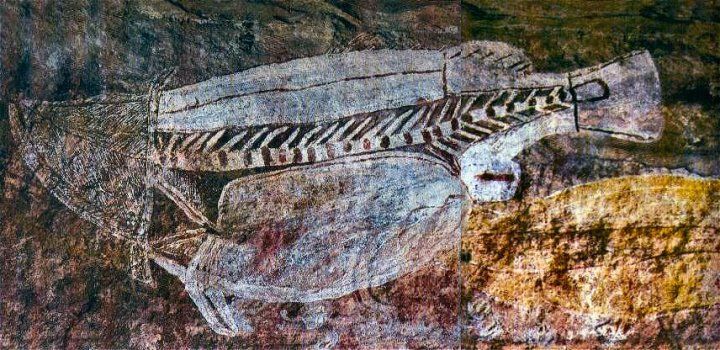
Animal of the Week June 13, 2005 -- Dreamtime fish

Hallo Freund der Tiere,

This week's Animal of the Week is Lates calcarifer (barramundi, Asian sea bass). Two fish are called barramundi; to avoid confusion, the other (Cromileptes altivelis) has been rebranded as the barramundi cod by the Fish Names Committee (I kid you not, it's a big thing in Australia). Dreamtime is the period in Australian myth when the world and the creatures on it were formed, and the barramundi features prominently among the legends about this period. Barramundi is an Australian name meaning "river fish with large scales". One story has it that the Giant Dreaming Barramundi Fish, in escaping the hunter Nagongbid, created the East Alligator River (you will, like me, be perplexed as to why there is an "Alligator River" in a country famed for its crocodiles and distinct lack of alligators). In another story, two young lovers called Yungi and Meyalk run away from the tribe so that they can be together as Meyalk is promised to an older man who she doesn't love. This disobedience is an offence punishable by death. Pursued by their tribesmen, the pair escaped into the sea where they transformed into barramundi; the spines on barramundis' backs were created from the spears thrown at Yungi and Meyalk. Barramundi are popular food fish and are farmed across southeast Asia and Australia; earlier this year the Australian Fish Names Committee launched a campaign to ban other nations from using the name barramundi, claiming people were cashing in on an Australian image of the Bush Tucker Man—an image more Paul Hogan than Nagongbid.

After 6 months of weekly updates the animals and I are puffed, so over the next few weeks we're all going to take a couple of breaks. Service will be fortnightly for the next 4 weeks. I apologise for the temporarily misleading nature of the name. Next week, as there will be no animal, you might like to choose your favourite from the past and revisit it.

Monday, June 06, 2005

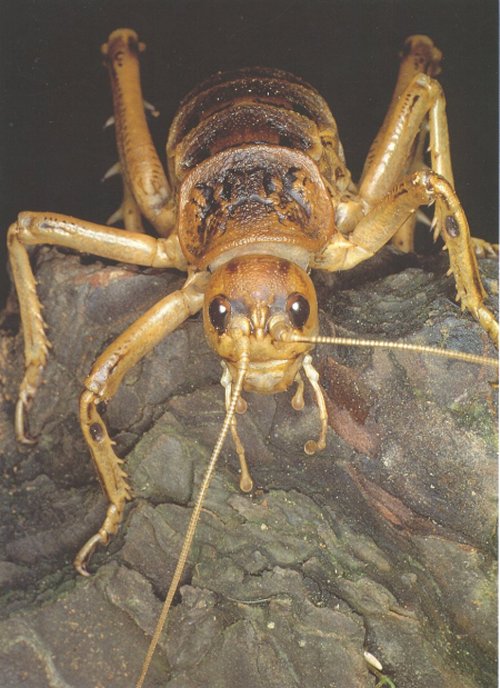
Animal of the Week June 06, 2005 -- Oi va voi, what's this?

Hello Chums,

This week's animal of the week is Deinacrida heteracantha (giant weta, wetapunga, Little Barrier Isalnd weta, demon grasshopper). Our recipient in the land of the long white cloud will likely be more than familiar with wetas by now, but others among you (those who never watched Shortland Street) may not be. Weta's are ancient flightless crickets, although widespread in the southern hemisphere they have reached astounding diversity and size on New Zealand. Until the maoris delivered the polynesian rat a thousand or so years ago and Europeans took ferrets to the islands a couple of hundred years ago, wetas filled the ecological niches filled by small mammals. Giant wetas, known to Maoris as "god of small ugly things", are the heaviest insects in all the world. The heaviest recorded weighed 71 g, not huge granted, but still, three times the size of a house mouse. Despite their less than cuddly appearence, weta's are quite docile, this is what comes from evolving where your most feared predator is a kiwi. In hit ninetess soap opera, Shortland Street, plucky female nurse Carmen was afraid of wetas, with hilarious consequences.

I give you the following song: a man named Johnny eats things that bite him. He also eats a weta which does not, according to the available history, appear to have bitten Johnny. This seems unfair to the weta. I believe it should be sung to the tune of Alouetta http://folksong.org.nz/ate_a_weta/

[Chorus]Ate a wetaJohnny ate a weta, Ate a weta Johnny ate one too!
Johnny ate a katipo, 'cos it bit him on the toe. Katipo, on the toe, and then a weta . . . . Chorus.
Johnny ate a Buller eel, cos it bit him on the heel. Buller eel, on the heel Katipo, on the toe and then a weta . . . . Chorus.
Johnny ate a bumble bee, cos it bit him on the knee. ETC Johnny ate a big sandfly, cos it bit him on the thigh.
Johnny ate a possum, cos it bit him on the bottom. Johnny ate a mountain goat, cos it bit him on the throat. Johnny ate a wild deer, cos it bit him on the ear.